F3i — IA Redesign & Design System
ROLE
Sole UX Designer
IMPACT
+106% traffic mo/mo
TIMELINE
Under 4 weeks
PLATFORM
Squarespace

Sole UX Designer
+106% traffic mo/mo
Under 4 weeks
Squarespace
F3 Innovate is a Central California nonprofit advancing agricultural infrastructure. My agency was brought in to redesign their public website and build an event design system ahead of a major stakeholder conference — as the sole designer, with under four weeks on the clock.


pages before
pages after
Traffic · 30 days
Unique vistors mo/mo
F3i's leadership came to us with a direct diagnosis: people visiting the site didn't understand what F3i actually does. For an organization trying to build credibility with government policy partners, attract donors, and connect with the farming community, that's a critical failure. The site existed but it just couldn't do its job.
The timing made this urgent. The stakeholder conference was the organization's highest-visibility moment of the year. The site would be the first thing attendees looked up before walking into the room. A confusing website wasn't just a brand problem, it undermined institutional credibility at the exact moment it mattered most.
Working within these constraints shaped every decision:
No room to run a full discovery process. Decisions had to be made with the information available and iterated quickly.
Existing brand assets had no system behind them. Logo, icons, colors, and graphics, but no components, no rules, no web-ready anything.
The site served three audiences with different needs and different levels of familiarity with F3i:
The conference was built for them. Needed to quickly grasp F3i's scope and relevance to their policy priorities. Credibility signals mattered more to this group than anything else.
Needed proof of impact. What F3i does, what it has built, why it's worth backing. Mission statements don't move this audience; concrete programs and outcomes do.
(Agtech startups, farming enterprises) Needed to know specifically what F3i could do for them. Not an organizational overview, but a direct path to the relevant program.
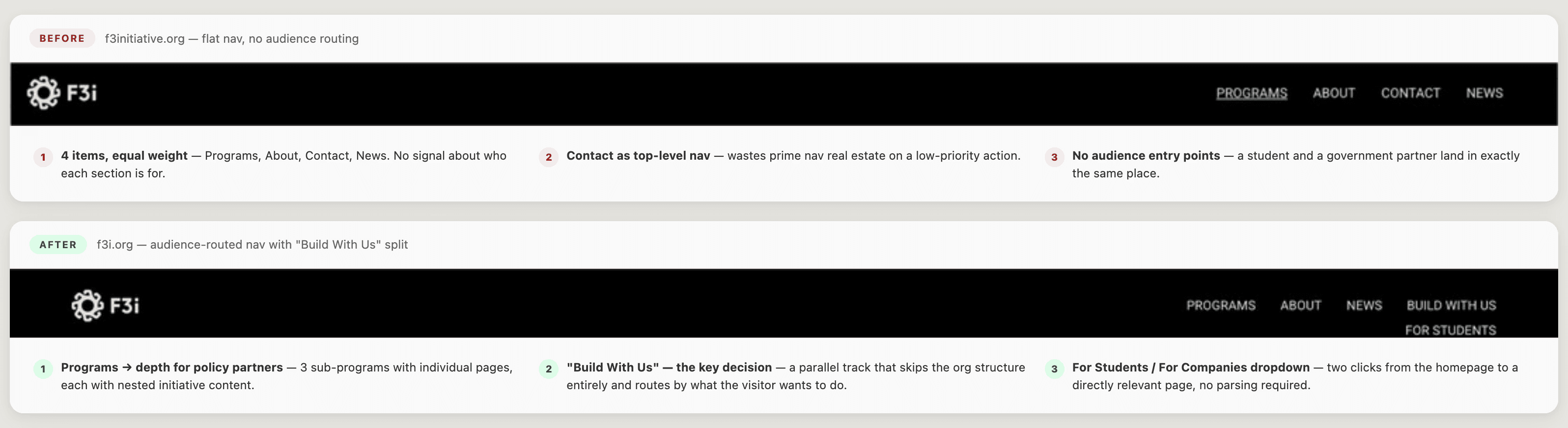
The original nav treated all vistors equally. The redesign directed each audience: policy partners, donors, students, companies, to the content built for their specific goals.
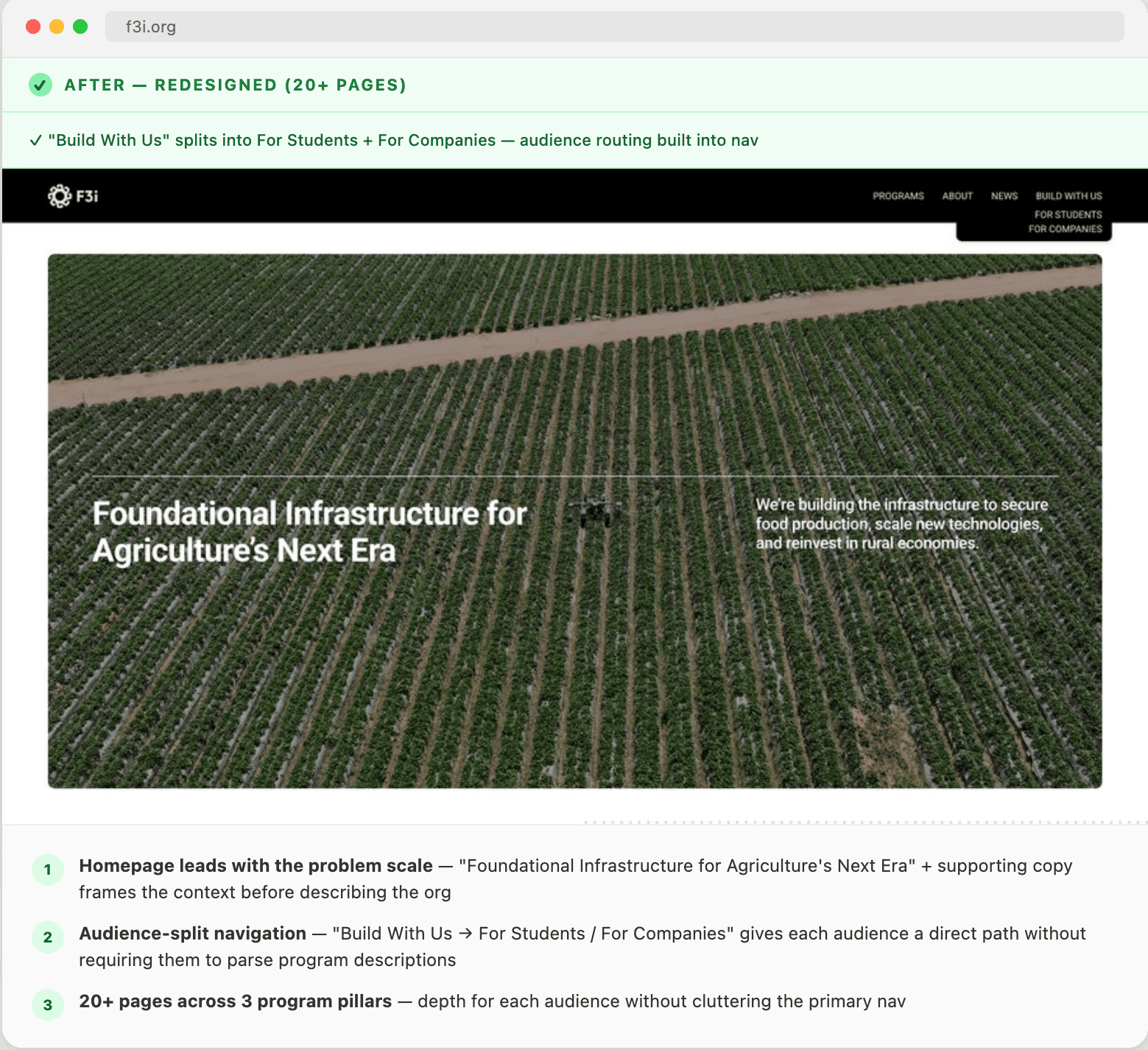
F3i's original brief organized the site around what the organization does internally. The redesigned navigation adds a 'Build With Us' section split explicitly into For Students and For Companies, pulling audience-specific content out of generic program pages and giving each group a direct entry point.
This was a deliberate departure from the inherited structure. A potential donor and a student looking at the same Programs page were going to leave with different levels of confusion. Separating them in the nav resolved that without requiring separate sites.
With 20+ pages to deliver in under four weeks and brand assets arriving mid-project, I made the call to establish a visual system first rather than designing pages individually. When new assets arrived mid-project, I updated the system once and the changes propagated.
Without this decision, mid-project asset changes would have required retrofitting every page, which, on a four-week timeline, would have meant shipping inconsistent work.
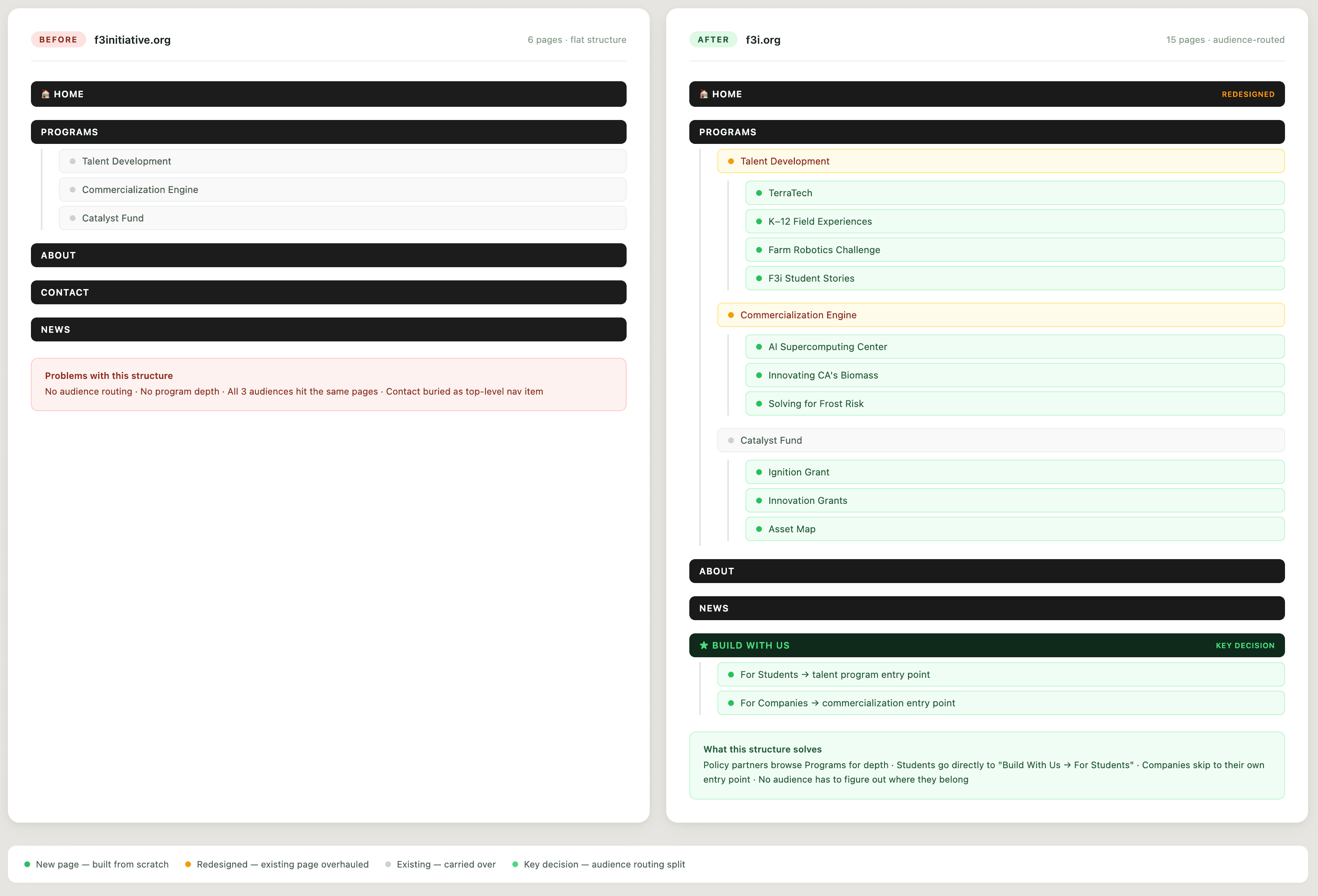

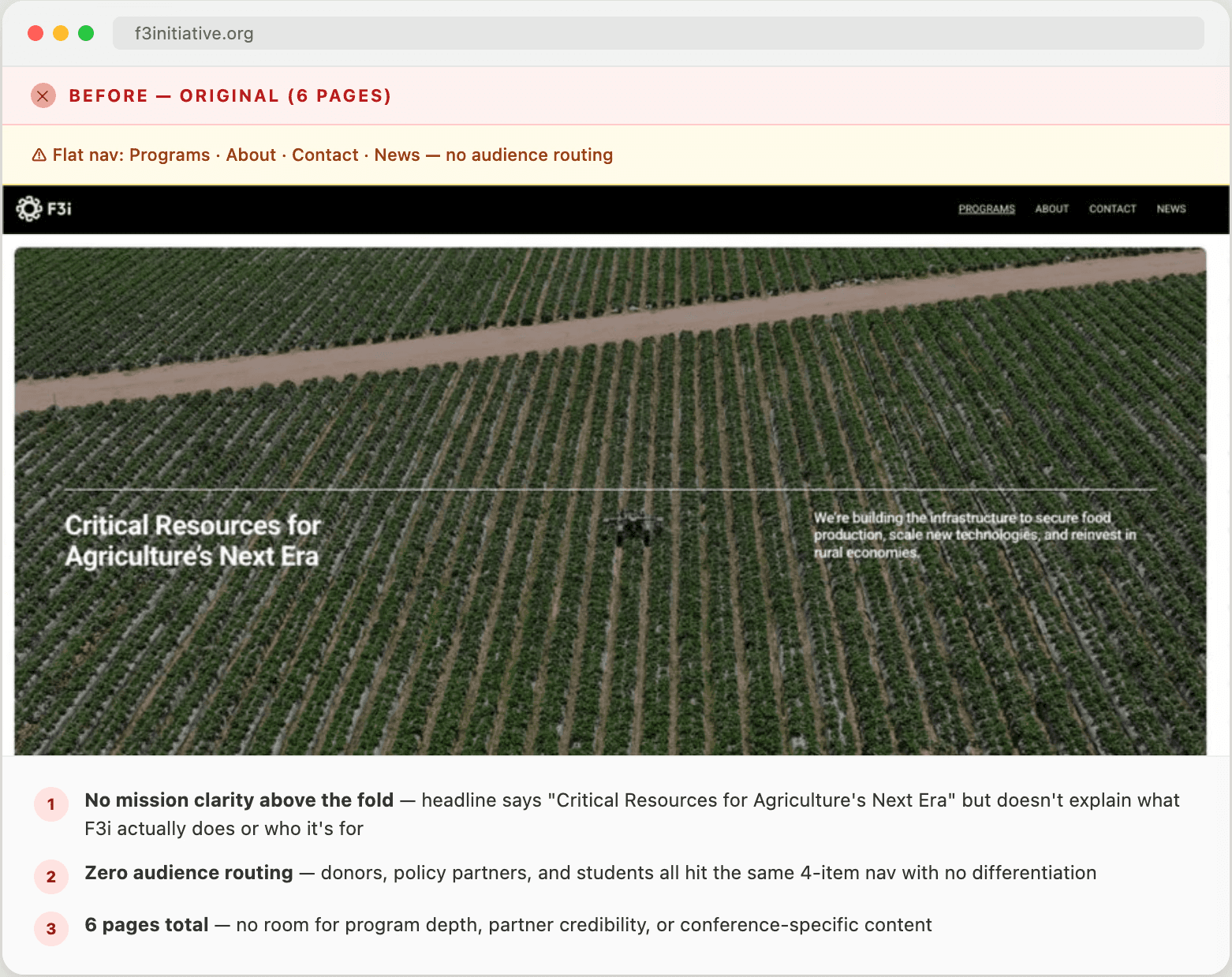
F3i provided a rough Canva sitemap: a starting list of pages, not a finished IA. I audited the existing six-page site against the brief and mapped each page to the key questions visitors would ask.
The structure was organization-centric rather than visitor-centric, so I rebuilt the information architecture before moving into visual design. This stable foundation made it easy to integrate new brand assets that arrived mid-project without restructuring the site.
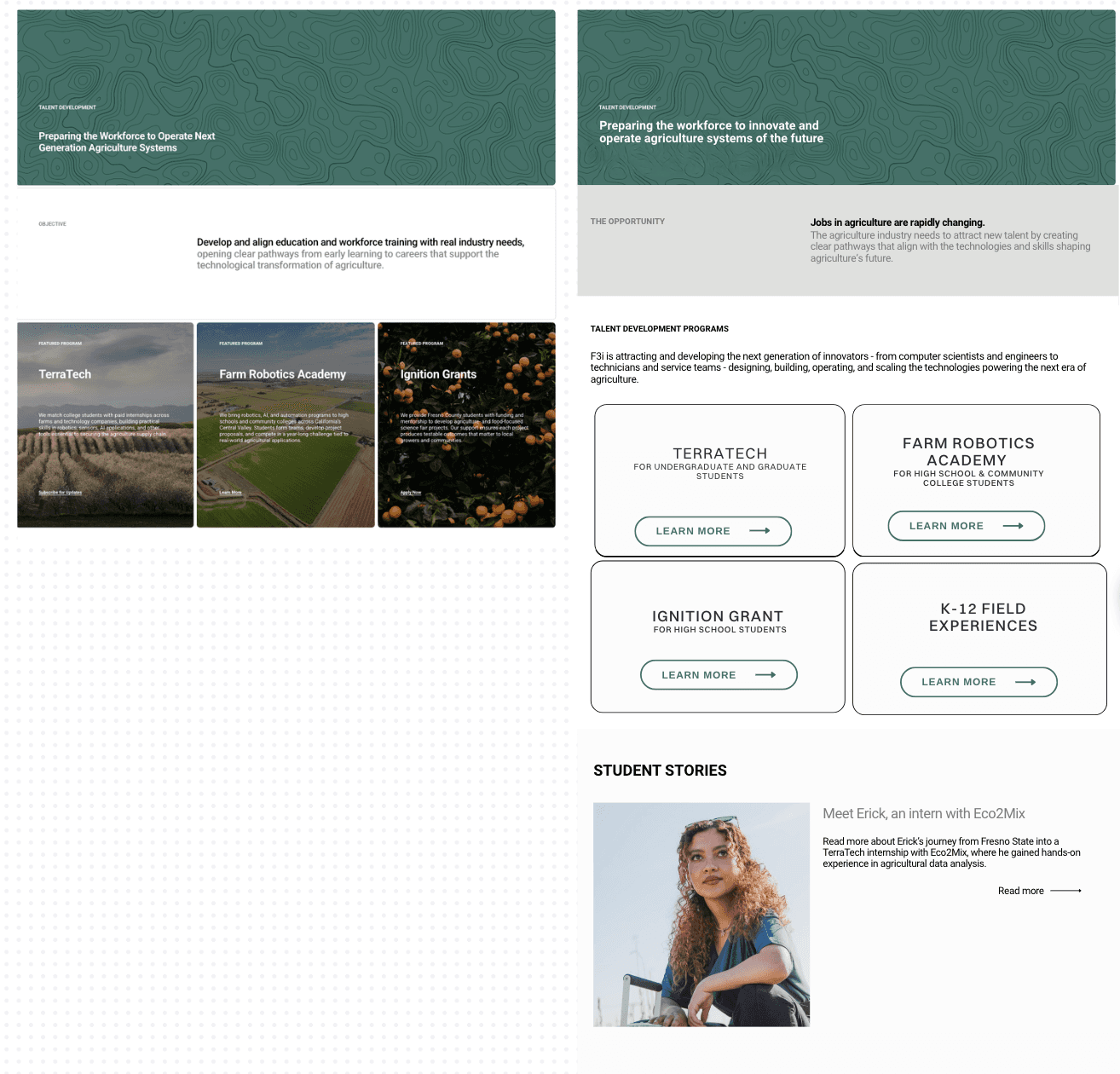
A 20+ page Squarespace site organized around three program pillars: Talent Development, Commercialization Engine, and Catalyst Fund, with audience-specific entry points built into the navigation.
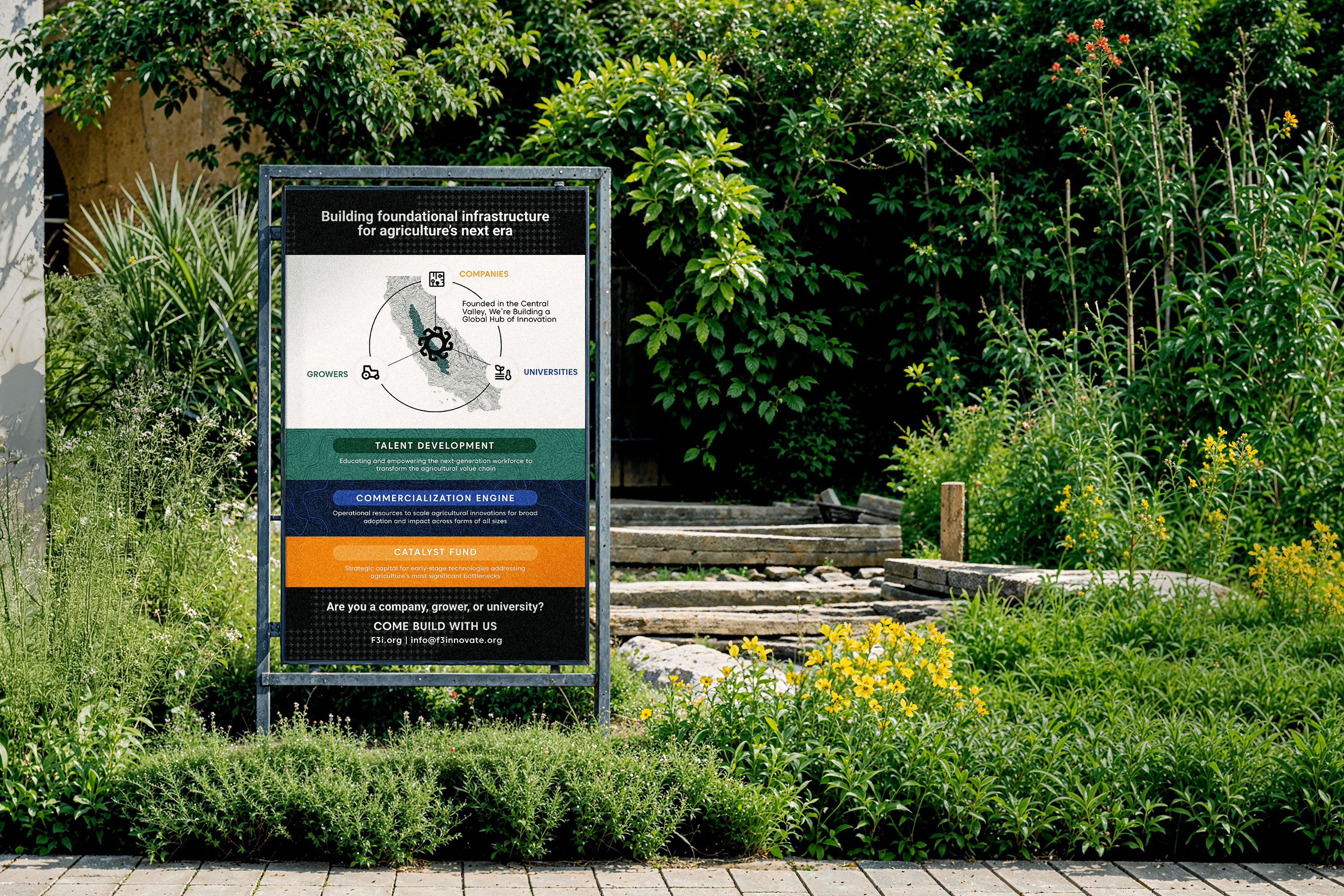
A complete event design system (posters, print collateral, digital assets) built on the same visual foundation, so every conference touchpoint pointed back to a site that could hold its own.
The homepage leads with the scale of the problem F3i exists to solve, then explains the organization, then routes visitors to the content relevant to them.

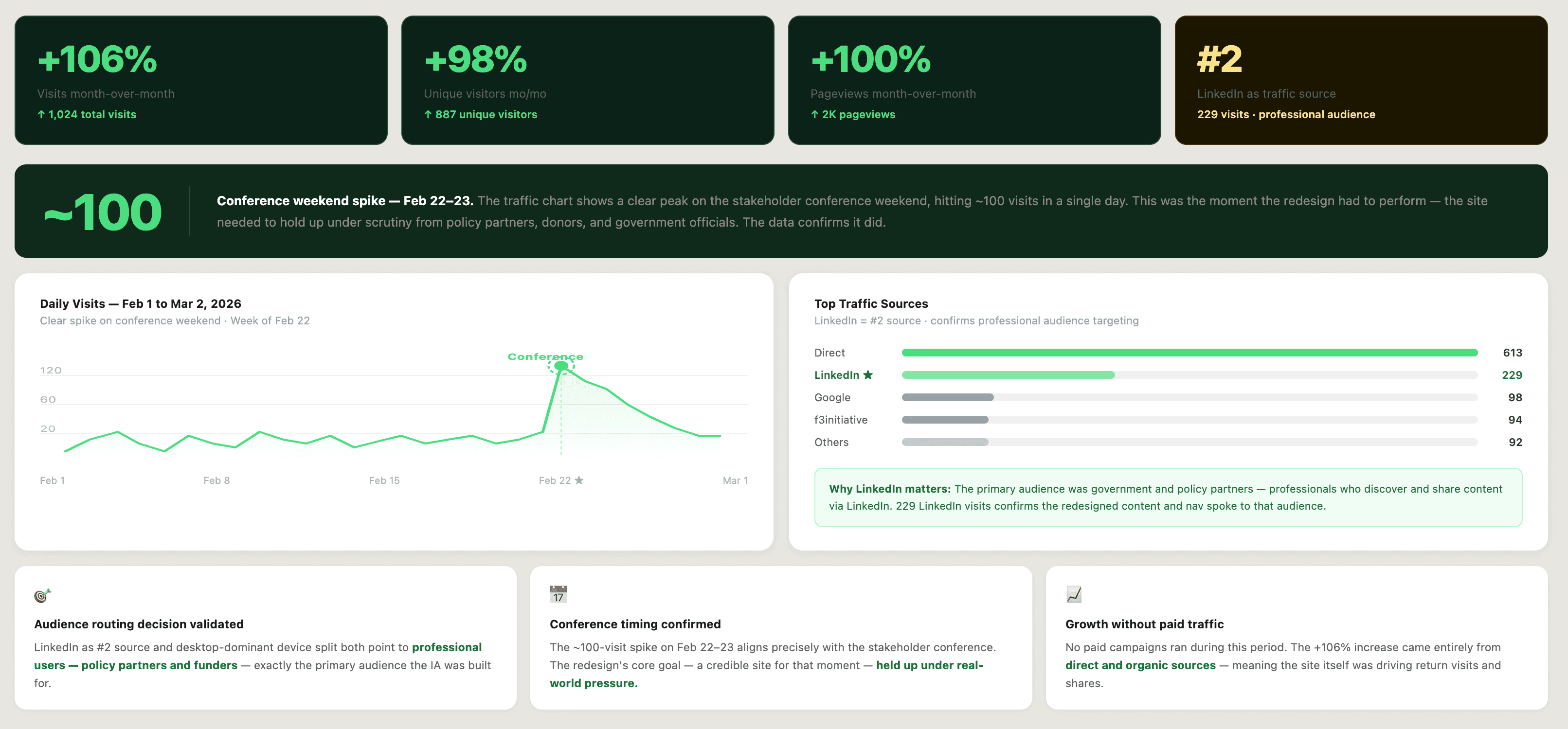
The site launched before the February stakeholder conference. One month of post-launch data from Squarespace Analytics shows the following, compared to the prior period:
The traffic chart shows a clear spike on the conference weekend (around Feb 22–23), confirming the site was being actively referenced during the event.
LinkedIn was the #2 traffic source at 229 visits, behind only direct traffic (613). The primary audience for the site was government and policy partners which were professionals who move through LinkedIn. The IA decision to give that audience a direct entry point appears to have supported how they actually arrived and navigated the site.
The structural decisions from this project are still reflected in the live site: the audience split in 'Build With Us,' the three-pillar program structure, the homepage hierarchy. The organization adopted and continued using the system after delivery.


Sole UX Designer
+106% traffic mo/mo
Under 4 weeks
Squarespace
F3i's leadership came to us with a direct diagnosis: people visiting the site didn't understand what F3i actually does. For an organization trying to build credibility with government policy partners, attract donors, and connect with the farming community, that's a critical failure. The site existed but it just couldn't do its job.The timing made this urgent. The stakeholder conference was the organization's highest-visibility moment of the year. The site would be the first thing attendees looked up before walking into the room. A confusing website wasn't just a brand problem, it undermined institutional credibility at the exact moment it mattered most.


pages before
pages after
Traffic · 30 days
Unique vistors mo/mo
F3i's leadership came to us with a direct diagnosis: people visiting the site didn't understand what F3i actually does. For an organization trying to build credibility with government policy partners, attract donors, and connect with the farming community, that's a critical failure. The site existed but it just couldn't do its job.The timing made this urgent. The stakeholder conference was the organization's highest-visibility moment of the year. The site would be the first thing attendees looked up before walking into the room. A confusing website wasn't just a brand problem, it undermined institutional credibility at the exact moment it mattered most.
Working within these constraints shaped every decision:
No room to run a full discovery process. Decisions had to be made with the information available and iterated quickly.
Existing brand assets had no system behind them. Logo, icons, colors, and graphics, but no components, no rules, no web-ready anything.
The site served three audiences with different needs and different levels of familiarity with F3i:
The conference was built for them. Needed to quickly grasp F3i's scope and relevance to their policy priorities. Credibility signals mattered more to this group than anything else.
Needed proof of impact. What F3i does, what it has built, why it's worth backing. Mission statements don't move this audience; concrete programs and outcomes do.
(Agtech startups, farming enterprises) Needed to know specifically what F3i could do for them. Not an organizational overview, but a direct path to the relevant program.
The original nav treated all vistors equally. The redesign directed each audience: policy partners, donors, students, companies, to the content built for their specific goals.
F3i's original brief organized the site around what the organization does internally. The redesigned navigation adds a 'Build With Us' section split explicitly into For Students and For Companies, pulling audience-specific content out of generic program pages and giving each group a direct entry point.
This was a deliberate departure from the inherited structure. A potential donor and a student looking at the same Programs page were going to leave with different levels of confusion. Separating them in the nav resolved that without requiring separate sites.

With 20+ pages to deliver in under four weeks and brand assets arriving mid-project, I made the call to establish a visual system first rather than designing pages individually. When new assets arrived mid-project, I updated the system once and the changes propagated.
Without this decision, mid-project asset changes would have required retrofitting every page, which, on a four-week timeline, would have meant shipping inconsistent work.


F3i provided a rough Canva sitemap: a starting list of pages, not a finished IA. I audited the existing six-page site against the brief and mapped each page to the key questions visitors would ask.
The structure was organization-centric rather than visitor-centric, so I rebuilt the information architecture before moving into visual design. This stable foundation made it easy to integrate new brand assets that arrived mid-project without restructuring the site.
A 20+ page Squarespace site organized around three program pillars: Talent Development, Commercialization Engine, and Catalyst Fund, with audience-specific entry points built into the navigation.
A complete event design system (posters, print collateral, digital assets) built on the same visual foundation, so every conference touchpoint pointed back to a site that could hold its own.
The homepage leads with the scale of the problem F3i exists to solve, then explains the organization, then routes visitors to the content relevant to them.

LinkedIn was the #2 traffic source at 229 visits, behind only direct traffic (613). The primary audience for the site was government and policy partners which were professionals who move through LinkedIn. The IA decision to give that audience a direct entry point appears to have supported how they actually arrived and navigated the site.
The structural decisions from this project are still reflected in the live site: the audience split in 'Build With Us,' the three-pillar program structure, the homepage hierarchy. The organization adopted and continued using the system after delivery.
The site launched before the February stakeholder conference. One month of post-launch data from Squarespace Analytics shows the following, compared to the prior period:
The traffic chart shows a clear spike on the conference weekend (around Feb 22–23), confirming the site was being actively referenced during the event.


Sole UX Designer
+106% traffic mo/mo
Under 4 weeks
Squarespace
F3 Innovate is a Central California nonprofit advancing agricultural infrastructure. My agency was brought in to redesign their public website and build an event design system ahead of a major stakeholder conference — as the sole designer, with under four weeks on the clock.


pages before
pages after
Traffic · 30 days
Unique vistors mo/mo
F3i's leadership came to us with a direct diagnosis: people visiting the site didn't understand what F3i actually does. For an organization trying to build credibility with government policy partners, attract donors, and connect with the farming community, that's a critical failure. The site existed but it just couldn't do its job.
The timing made this urgent. The stakeholder conference was the organization's highest-visibility moment of the year. The site would be the first thing attendees looked up before walking into the room. A confusing website wasn't just a brand problem, it undermined institutional credibility at the exact moment it mattered most.
Working within these constraints shaped every decision:
No room to run a full discovery process. Decisions had to be made with the information available and iterated quickly.
Existing brand assets had no system behind them. Logo, icons, colors, and graphics, but no components, no rules, no web-ready anything.
The site served three audiences with different needs and different levels of familiarity with F3i:
The conference was built for them. Needed to quickly grasp F3i's scope and relevance to their policy priorities. Credibility signals mattered more to this group than anything else.
Needed proof of impact. What F3i does, what it has built, why it's worth backing. Mission statements don't move this audience; concrete programs and outcomes do.
(Agtech startups, farming enterprises) Needed to know specifically what F3i could do for them. Not an organizational overview, but a direct path to the relevant program.
The original nav treated all vistors equally. The redesign directed each audience: policy partners, donors, students, companies, to the content built for their specific goals.
F3i's original brief organized the site around what the organization does internally. The redesigned navigation adds a 'Build With Us' section split explicitly into For Students and For Companies, pulling audience-specific content out of generic program pages and giving each group a direct entry point.
This was a deliberate departure from the inherited structure. A potential donor and a student looking at the same Programs page were going to leave with different levels of confusion. Separating them in the nav resolved that without requiring separate sites.

With 20+ pages to deliver in under four weeks and brand assets arriving mid-project, I made the call to establish a visual system first rather than designing pages individually. When new assets arrived mid-project, I updated the system once and the changes propagated.
Without this decision, mid-project asset changes would have required retrofitting every page, which, on a four-week timeline, would have meant shipping inconsistent work.


F3i provided a rough Canva sitemap: a starting list of pages, not a finished IA. I audited the existing six-page site against the brief and mapped each page to the key questions visitors would ask.
The structure was organization-centric rather than visitor-centric, so I rebuilt the information architecture before moving into visual design. This stable foundation made it easy to integrate new brand assets that arrived mid-project without restructuring the site.
A 20+ page Squarespace site organized around three program pillars: Talent Development, Commercialization Engine, and Catalyst Fund, with audience-specific entry points built into the navigation.
A complete event design system (posters, print collateral, digital assets) built on the same visual foundation, so every conference touchpoint pointed back to a site that could hold its own.
The homepage leads with the scale of the problem F3i exists to solve, then explains the organization, then routes visitors to the content relevant to them.

LinkedIn was the #2 traffic source at 229 visits, behind only direct traffic (613). The primary audience for the site was government and policy partners which were professionals who move through LinkedIn. The IA decision to give that audience a direct entry point appears to have supported how they actually arrived and navigated the site.
The structural decisions from this project are still reflected in the live site: the audience split in 'Build With Us,' the three-pillar program structure, the homepage hierarchy. The organization adopted and continued using the system after delivery.
The site launched before the February stakeholder conference. One month of post-launch data from Squarespace Analytics shows the following, compared to the prior period:
The traffic chart shows a clear spike on the conference weekend (around Feb 22–23), confirming the site was being actively referenced during the event.