Ryde Profile System Redesign

ROLE

Product Designer

TEAM

Iter8 Consultancy · 7 People

TIMELINE

8 weeks

PLATFORM

Figma · Coda

OVERVIEW

A profile redesign built around one question: why don't users trust each other?

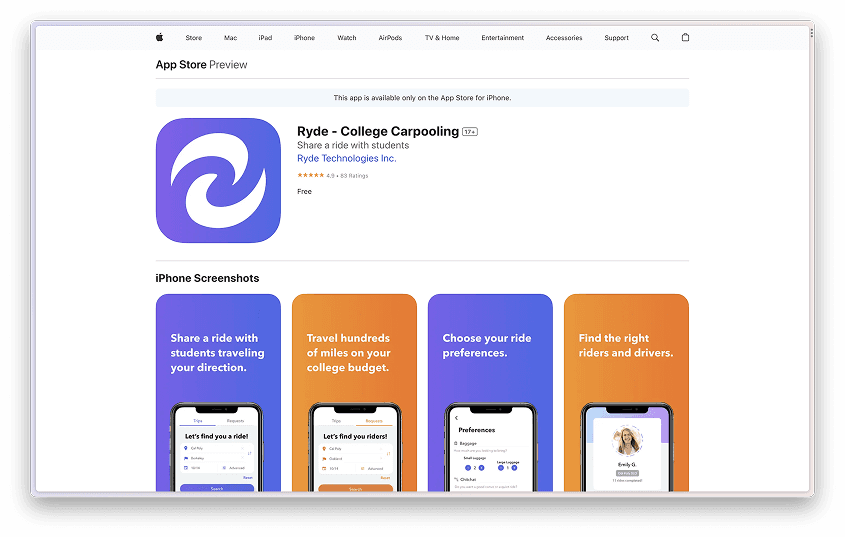
Ryde is a carpooling app built for college students. Thousands of Cal Poly SLO students use it to share rides home for breaks, weekends, and holidays. As part of Cal Poly's Iter8 design consultancy, I joined a 7-person team hired by Ryde to redesign their user profile experience over 8 weeks.
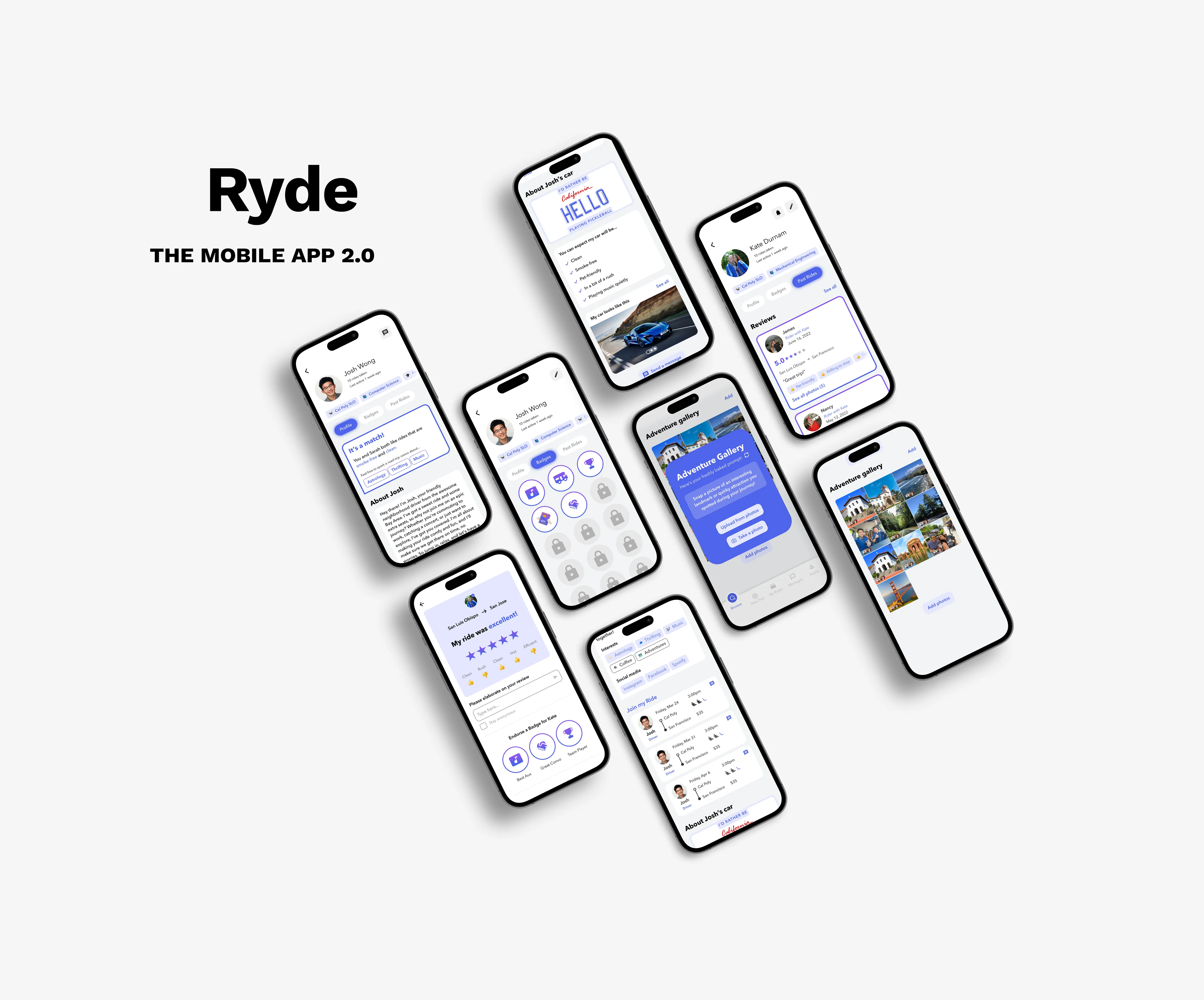
We worked directly with Ryde's founders in weekly standups, conducted our own focus groups with real users, and synthesized research Ryde had already gathered. The result was Profile 2.0, a trust-first redesign that gave riders and drivers the information, signals, and tools to feel confident sharing a car with a stranger.

328

Survey respondents in Ryde's research

20

In-depth user interviews

8

Weeks of client design sprints

3

HMW statements I authored

THE PROBLEM

"This wasn't a fringe behavior. It was the norm."

Ryde had a trust problem baked into the product. Before a ride, users had no way to learn who they were getting in a car with.

Pain Point 01

Safety anxiety — especially for women

Female riders went off-platform to locate mutual connections before a ride. One participant described going to social media "to get a better idea and feel more secure." The profile wasn't doing the job that trust requires.

Pain Point 02

The review system suppressed honesty

After hours in a car together, leaving a negative review felt like betrayal. No anonymous option. No text field. No driver response. Shallow star ratings that caught nothing, especially real safety issues.

Pain Point 03

Critical information didn't exist

Students wanted to know luggage capacity, planned stops, and car rules. None of that existed. Wanting basic driver info scored a mean of 4.29/5 with a std deviation of 0.90.

APPROACH

We opened the project with a research sprint before touching Figma.

Ryde shared their existing data: 20 in-depth interviews and a 382-person survey. We then ran our own focus group with three current users: a power driver with 30+ trips, a frequent out-of-state rider, and a top-rated transfer student driver.

What the focus group changed

Riders wanted to see other riders' profiles too — we flagged it, discussed with Ryde, and deliberately scoped to driver profiles for this sprint
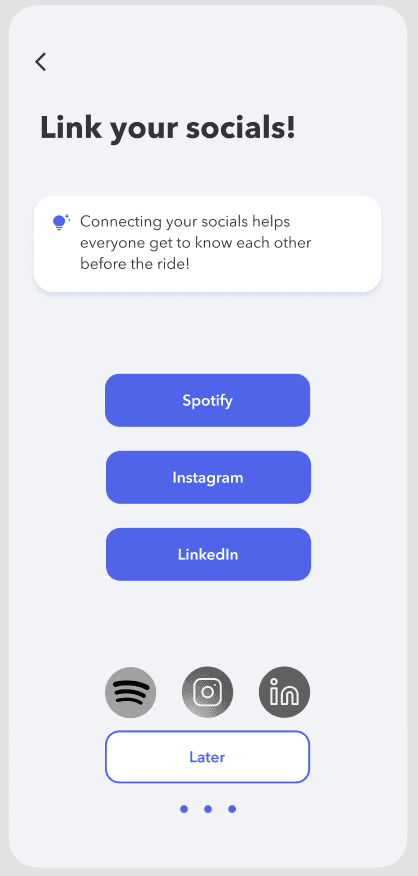
Communication was fragmented across Ryde, iMessage, and Instagram simultaneously
The review prompt fired right after a ride — when goodwill was highest and honesty was lowest

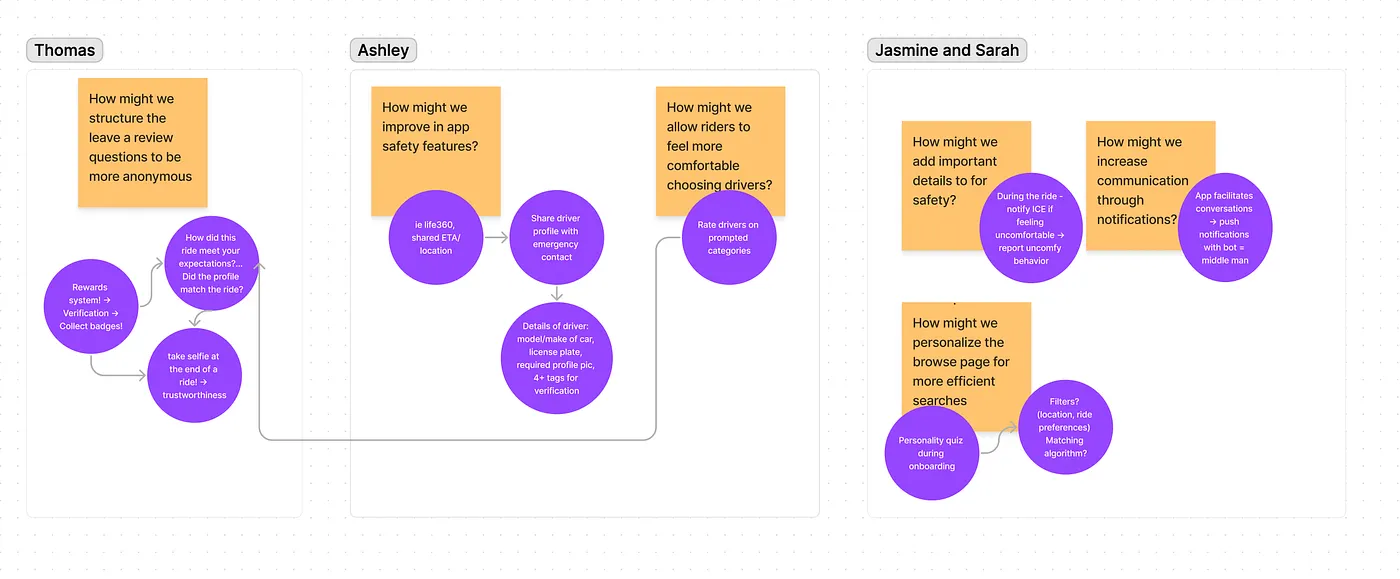
HMW Statements

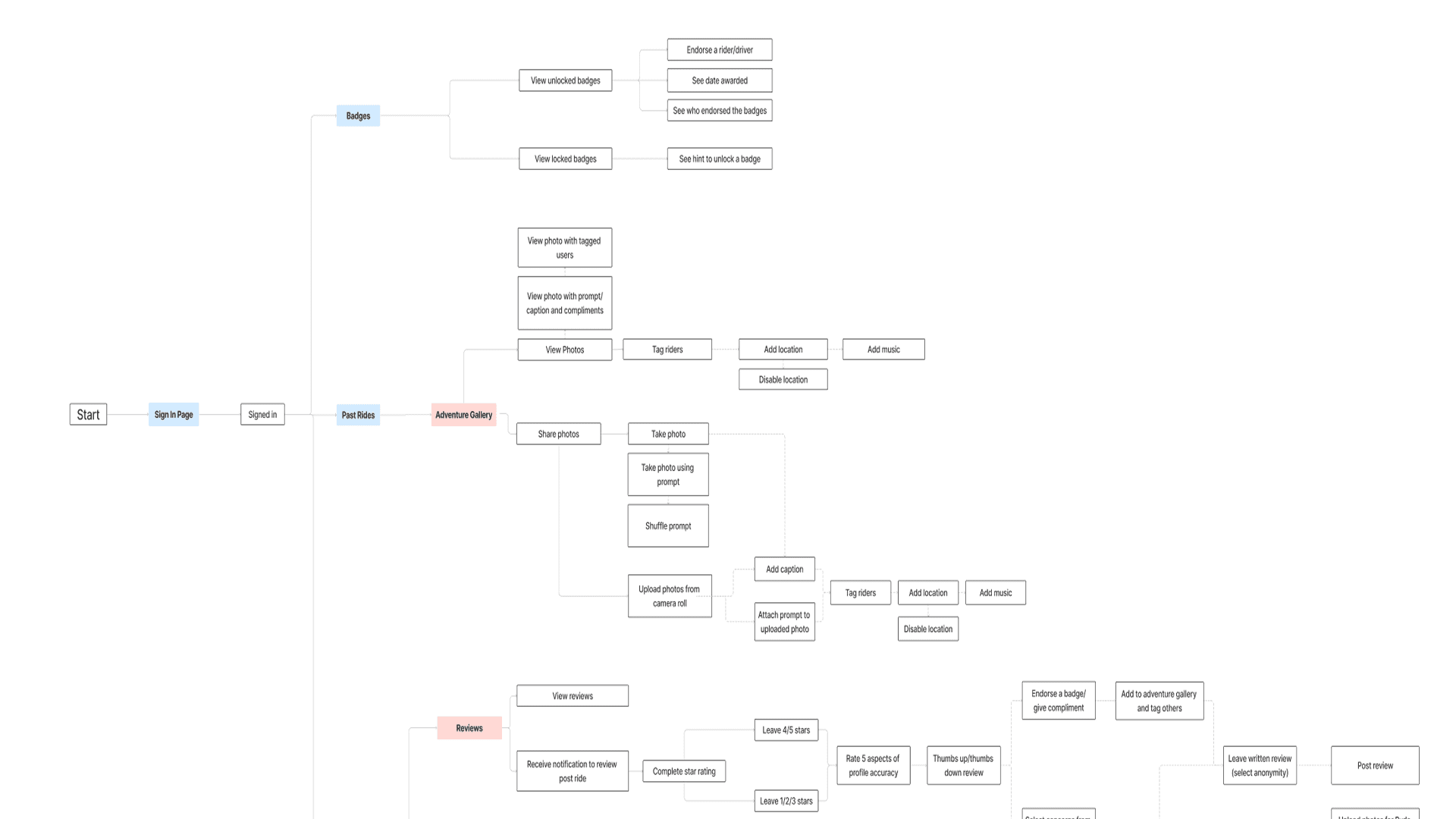
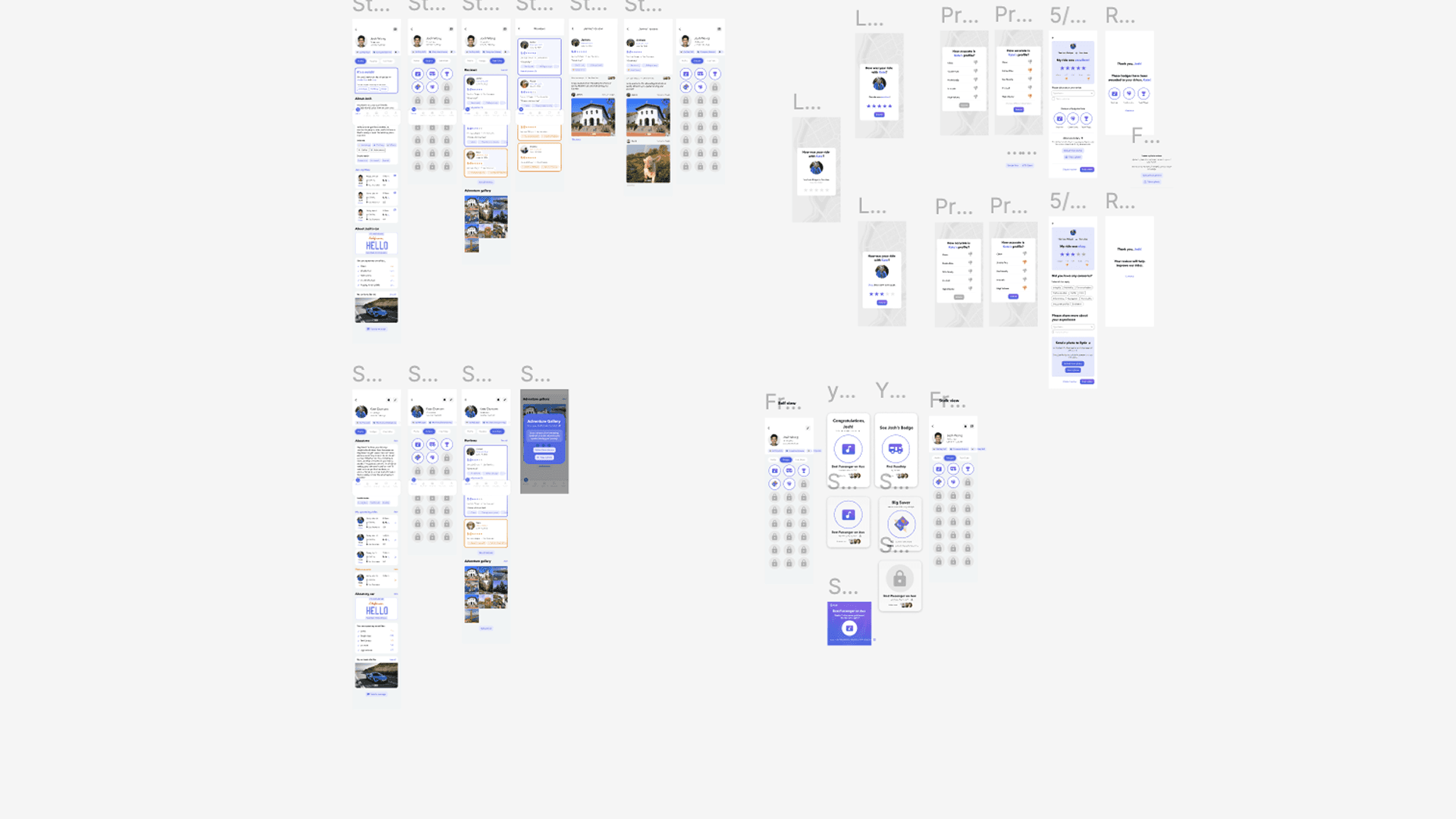
User Flow

KEY DECISIONS

DECISION 01

Making honesty feel safe

Ratings & Reviews — my feature

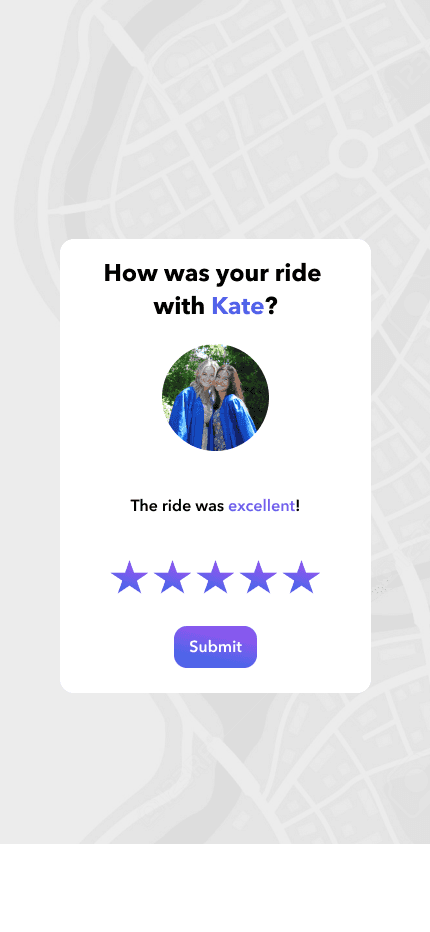
This was the hardest problem on the project. Ryde needed honest reviews for safety. But users were suppressing them. The social bond formed during a shared trip made criticism feel personal.

The tension: Mandatory public reviews made social pressure worse. My first approach, a public-only system with required text, meant users would either skip it or write something vague. Public accountability was the exact dynamic suppressing honesty.

"We want [reviews] to be a fun way for people to share positive experience. But they should also be a way for frustrated users to make their voice heard... an optional text-based review should be included, with an anonymous option if selected." — Ryde Co-founder 1 (client email)

That email reframed the goal: not to make reviews easier — but to make honesty feel safe.

  • Star rating + optional text field — structured for Ryde's support team, open enough for nuance

  • Anonymous toggle— breaks the social pressure loop without removing accountability

  • Driver response feature— lets recipients add context, Emily specifically requested this

  • Badge integration— positive review patterns surface as achievements, not just scores
DECISION 02

ID Tags: personality over forms

Compatibility without onboarding friction

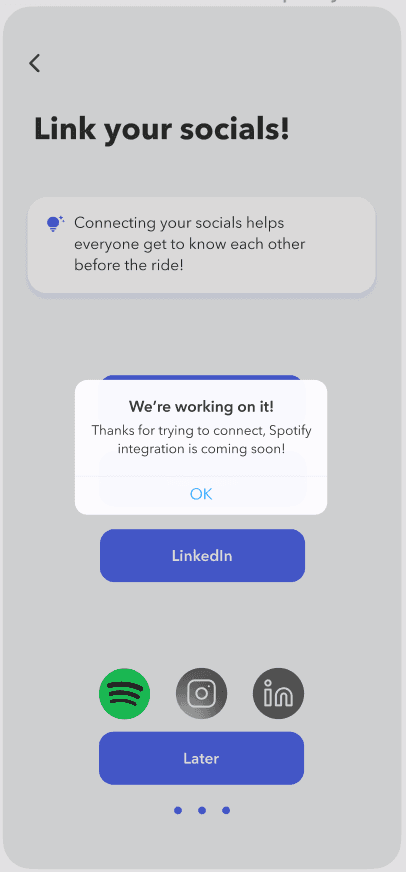
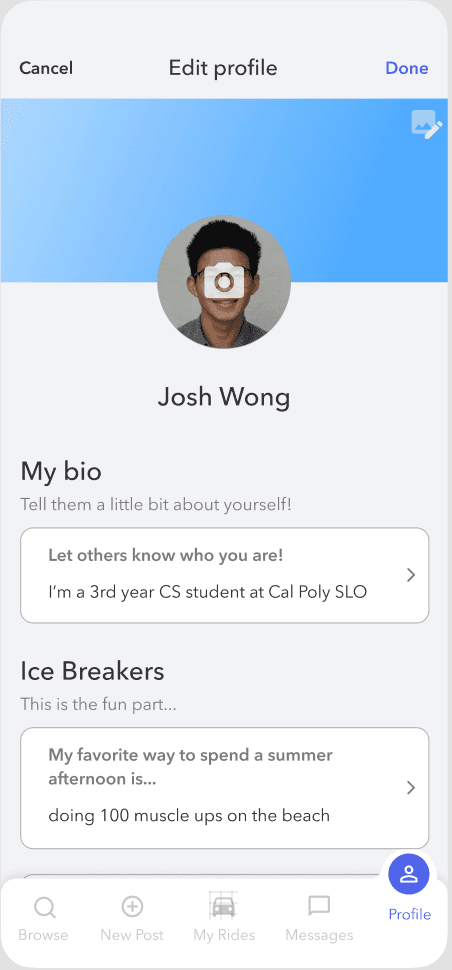
Riders and drivers wanted compatibility signals such asmusic taste, chattiness, car vibe, stop willingness. But a long profile questionnaire feels like a job application. Tags let users express personality in a low-effort, scannable format without writing a bio.

Why not a bio? Freeform bios have completion rates near zero in apps with optional fields. Tags are constrained, fast, and expressive and they feed the matching algorithm without cognitive load.

When we presented this in standup, the Ryde team confirmed users in their own research had been excited about it. We kept the vocabulary flexible and suggested tags plus write-your-own to avoid making it feel prescribed.

DECISION 03

Adventure Gallery: from utility to identity

Retention beyond the transaction

Ryde profiles were purely functional. There was no personality, no reason to return after a ride was booked. Ryde's founders wanted users engaged between trips, not just during booking.

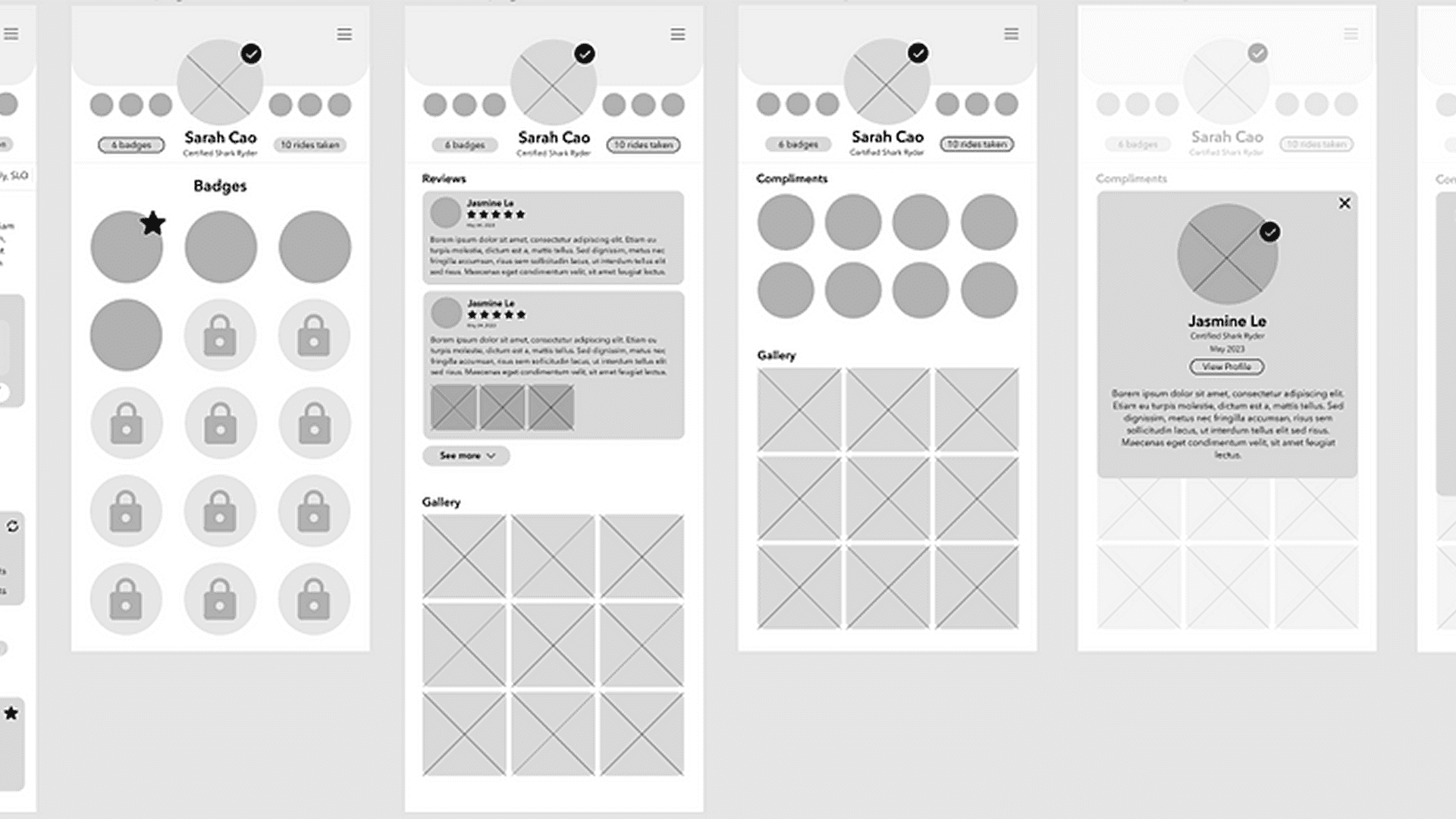
The Adventure Gallery let users post photos and videos from their rides: road trips, scenic stops, carpooling moments. Inspired by Airbnb's approach to user-generated content, we designed it to feel editorial rather than social feed: photos with captions, organized by trip. One constraint deliberately scoped out: live maps and real-time location which was validated in research but deprioritized by Ryde as a later engineering phase.

DECISION 04

Badges: turning data into trust signals

Stats that already existed, finally visible

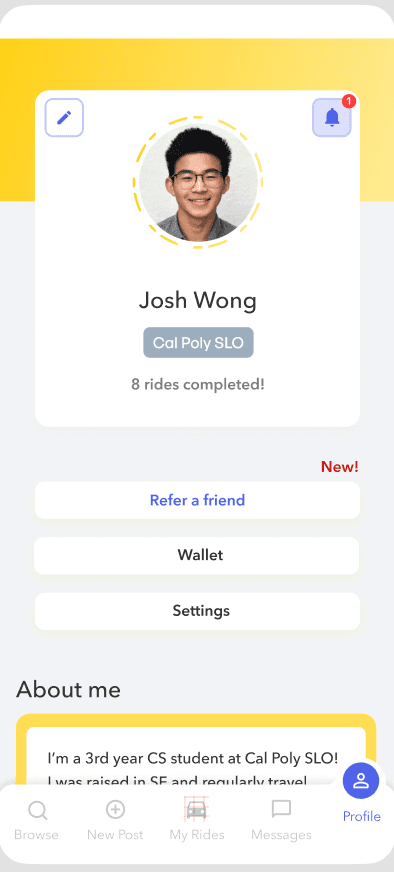
Ryde was already collecting rich data: miles traveled, rides completed, CO2 saved, money saved, but none of it appeared on profiles. A driver with 30 completed trips looked identical to someone with zero.

"They're collecting stats — showcase them." — Ryde Co-founder 2 (client standup)

Badges surface those stats as earnable achievements which acts as trust signals for riders, motivation for drivers. Badge taxonomy shaped directly by client standups: alumni badges that expire post-graduation, locked badges that show what you're working toward, event-specific badges tied to Ryde community moments.

PROCESS

OUTCOME

Profile 2.0 addressed the three structural failures in Ryde's original profile.

Over 8 weeks of standups, Ryde's founders confirmed all four feature directions for their next development cycle. Reviews and ID Tags were flagged as highest priority, directly mapping to the two pain points our research scored most severe.

Rider-side profiles were validated as the planned next phase: an expansion our focus group had already surfaced and we had deliberately scoped for later.

REFLECTION

"Reviews aren't a feature problem — they're a behavior problem. People don't leave honest feedback when they feel socially exposed."

The anonymous toggle was a small design decision that took the longest to get right, because it required understanding why users were holding back before I could design something that actually changed the behavior.

Working directly with Ryde's founders taught me that the best client relationships aren't sign-off loops but rather they're collaborations. Emily's email about the review system didn't just give me direction; it gave me a new frame for the problem. That's the kind of feedback that makes design better.

Smooth Scroll
This will hide itself!

Ryde Profile System Redesign

ROLE

Product Designer

TEAM

Iter8 Consultancy · 7 People

TIMELINE

8 weeks

PLATFORM

Figma · Coda

OVERVIEW

A profile redesign built around one question: why don't users trust each other?

Ryde is a carpooling app built for college students. Thousands of Cal Poly SLO students use it to share rides home for breaks, weekends, and holidays. As part of Cal Poly's Iter8 design consultancy, I joined a 7-person team hired by Ryde to redesign their user profile experience over 8 weeks.

We worked directly with Ryde's founders in weekly standups, conducted our own focus groups with real users, and synthesized research Ryde had already gathered. The result was Profile 2.0, a trust-first redesign that gave riders and drivers the information, signals, and tools to feel confident sharing a car with a stranger.

328

Survey respondents in Ryde's research

20

In-depth user interviews

8

Weeks of client design sprints

3

HMW statements I authored

THE PROBLEM

"This wasn't a fringe behavior. It was the norm."

Ryde had a trust problem baked into the product. Before a ride, users had no way to learn who they were getting in a car with.

Pain Point 01

Safety anxiety — especially for women

Female riders went off-platform to locate mutual connections before a ride. One participant described going to social media "to get a better idea and feel more secure." The profile wasn't doing the job that trust requires.

Pain Point 02

The review system suppressed honesty

After hours in a car together, leaving a negative review felt like betrayal. No anonymous option. No text field. No driver response. Shallow star ratings that caught nothing, especially real safety issues.

Pain Point 03

Critical information didn't exist

Students wanted to know luggage capacity, planned stops, and car rules. None of that existed. Wanting basic driver info scored a mean of 4.29/5 with a std deviation of 0.90.

APPROACH

We opened the project with a research sprint before touching Figma.

Ryde shared their existing data: 20 in-depth interviews and a 382-person survey. We then ran our own focus group with three current users: a power driver with 30+ trips, a frequent out-of-state rider, and a top-rated transfer student driver.

What the focus group changed

Riders wanted to see other riders' profiles too — we flagged it, discussed with Ryde, and deliberately scoped to driver profiles for this sprint
Communication was fragmented across Ryde, iMessage, and Instagram simultaneously
The review prompt fired right after a ride — when goodwill was highest and honesty was lowest

HMW Statements

User Flow

KEY DECISIONS

DECISION 01

Making honesty feel safe

Ratings & Reviews — my feature

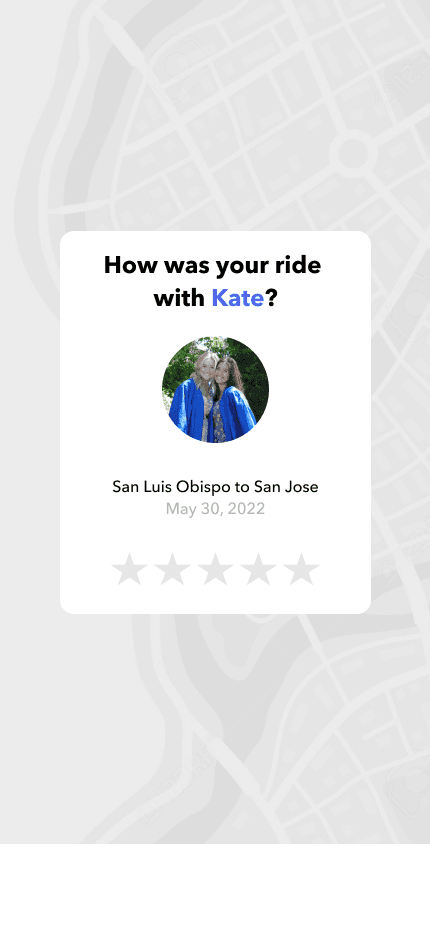
This was the hardest problem on the project. Ryde needed honest reviews for safety. But users were suppressing them. The social bond formed during a shared trip made criticism feel personal.

The tension: Mandatory public reviews made social pressure worse. My first approach, a public-only system with required text, meant users would either skip it or write something vague. Public accountability was the exact dynamic suppressing honesty.

"We want [reviews] to be a fun way for people to share positive experience. But they should also be a way for frustrated users to make their voice heard... an optional text-based review should be included, with an anonymous option if selected." — Ryde Co-founder 1 (client email)

That email reframed the goal: not to make reviews easier — but to make honesty feel safe.

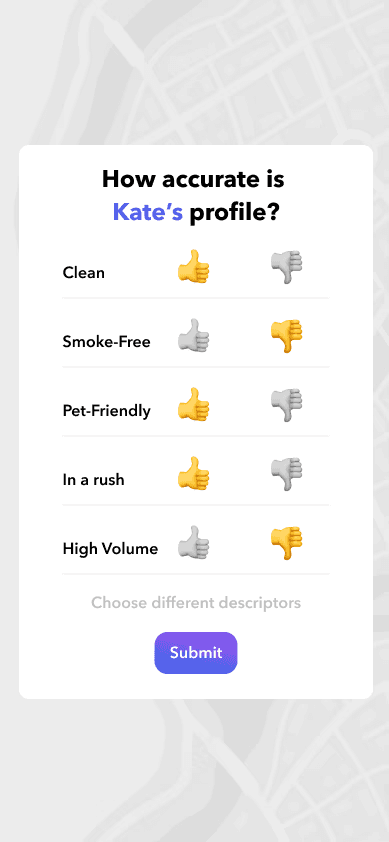
  • Star rating + optional text field — structured for Ryde's support team, open enough for nuance

  • Anonymous toggle— breaks the social pressure loop without removing accountability

  • Driver response feature— lets recipients add context, Emily specifically requested this

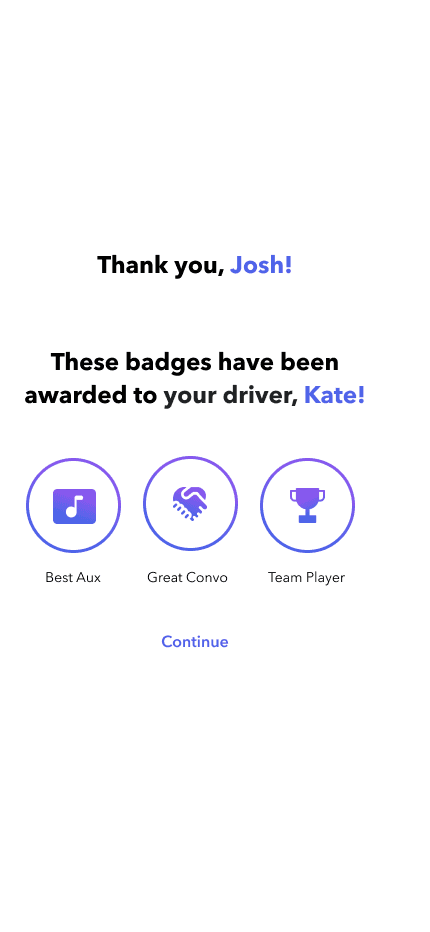
  • Badge integration— positive review patterns surface as achievements, not just scores
DECISION 02

ID Tags: personality over forms

Compatibility without onboarding friction

Riders and drivers wanted compatibility signals such asmusic taste, chattiness, car vibe, stop willingness. But a long profile questionnaire feels like a job application. Tags let users express personality in a low-effort, scannable format without writing a bio.

Why not a bio? Freeform bios have completion rates near zero in apps with optional fields. Tags are constrained, fast, and expressive and they feed the matching algorithm without cognitive load.

When we presented this in standup, the Ryde team confirmed users in their own research had been excited about it. We kept the vocabulary flexible and suggested tags plus write-your-own to avoid making it feel prescribed.

DECISION 03

Adventure Gallery: from utility to identity

Retention beyond the transaction

Ryde profiles were purely functional. There was no personality, no reason to return after a ride was booked. Ryde's founders wanted users engaged between trips, not just during booking.

The Adventure Gallery let users post photos and videos from their rides: road trips, scenic stops, carpooling moments. Inspired by Airbnb's approach to user-generated content, we designed it to feel editorial rather than social feed: photos with captions, organized by trip. One constraint deliberately scoped out: live maps and real-time location which was validated in research but deprioritized by Ryde as a later engineering phase.

DECISION 04

Badges: turning data into trust signals

Stats that already existed, finally visible

Ryde was already collecting rich data: miles traveled, rides completed, CO2 saved, money saved, but none of it appeared on profiles. A driver with 30 completed trips looked identical to someone with zero.

"They're collecting stats — showcase them." — Ryde Co-founder 2 (client standup)

Badges surface those stats as earnable achievements which acts as trust signals for riders, motivation for drivers. Badge taxonomy shaped directly by client standups: alumni badges that expire post-graduation, locked badges that show what you're working toward, event-specific badges tied to Ryde community moments.

PROCESS

OUTCOME

Profile 2.0 addressed the three structural failures in Ryde's original profile.

Over 8 weeks of standups, Ryde's founders confirmed all four feature directions for their next development cycle. Reviews and ID Tags were flagged as highest priority, directly mapping to the two pain points our research scored most severe.

Rider-side profiles were validated as the planned next phase: an expansion our focus group had already surfaced and we had deliberately scoped for later.

REFLECTION

"Reviews aren't a feature problem — they're a behavior problem. People don't leave honest feedback when they feel socially exposed."

The anonymous toggle was a small design decision that took the longest to get right, because it required understanding why users were holding back before I could design something that actually changed the behavior.

Working directly with Ryde's founders taught me that the best client relationships aren't sign-off loops but rather they're collaborations. Emily's email about the review system didn't just give me direction; it gave me a new frame for the problem. That's the kind of feedback that makes design better.

Smooth Scroll
This will hide itself!

Ryde Profile System Redesign

ROLE

Product Designer

TEAM

Iter8 Consultancy · 7 People

TIMELINE

8 weeks

PLATFORM

Figma · Coda

OVERVIEW

A profile redesign built around one question: why don't users trust each other?

Ryde is a carpooling app built for college students. Thousands of Cal Poly SLO students use it to share rides home for breaks, weekends, and holidays. As part of Cal Poly's Iter8 design consultancy, I joined a 7-person team hired by Ryde to redesign their user profile experience over 8 weeks.

We worked directly with Ryde's founders in weekly standups, conducted our own focus groups with real users, and synthesized research Ryde had already gathered. The result was Profile 2.0, a trust-first redesign that gave riders and drivers the information, signals, and tools to feel confident sharing a car with a stranger.

328

Survey respondents in Ryde's research

20

In-depth user interviews

8

Weeks of client design sprints

3

HMW statements I authored

THE PROBLEM

"This wasn't a fringe behavior. It was the norm."

Ryde had a trust problem baked into the product. Before a ride, users had no way to learn who they were getting in a car with.

Pain Point 01

Safety anxiety — especially for women

Female riders went off-platform to locate mutual connections before a ride. One participant described going to social media "to get a better idea and feel more secure." The profile wasn't doing the job that trust requires.

Pain Point 02

The review system suppressed honesty

After hours in a car together, leaving a negative review felt like betrayal. No anonymous option. No text field. No driver response. Shallow star ratings that caught nothing, especially real safety issues.

Pain Point 03

Critical information didn't exist

Students wanted to know luggage capacity, planned stops, and car rules. None of that existed. Wanting basic driver info scored a mean of 4.29/5 with a std deviation of 0.90.

APPROACH

We opened the project with a research sprint before touching Figma.

Ryde shared their existing data: 20 in-depth interviews and a 382-person survey. We then ran our own focus group with three current users: a power driver with 30+ trips, a frequent out-of-state rider, and a top-rated transfer student driver.

What the focus group changed

Riders wanted to see other riders' profiles too — we flagged it, discussed with Ryde, and deliberately scoped to driver profiles for this sprint
Communication was fragmented across Ryde, iMessage, and Instagram simultaneously
The review prompt fired right after a ride — when goodwill was highest and honesty was lowest

HMW Statements

User Flow

KEY DECISIONS

DECISION 01

Making honesty feel safe

Ratings & Reviews — my feature

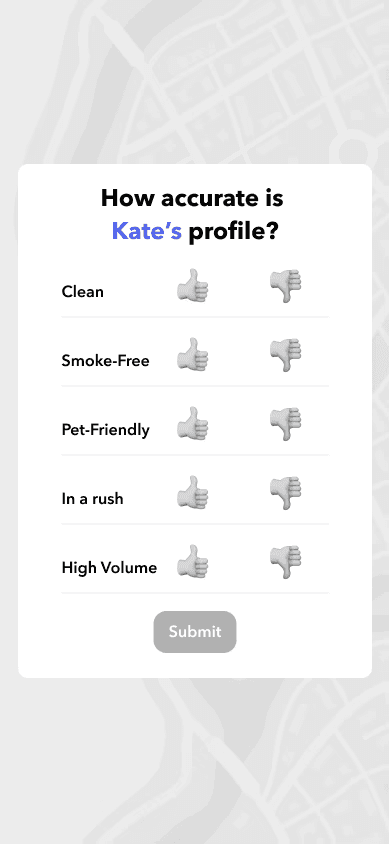
This was the hardest problem on the project. Ryde needed honest reviews for safety. But users were suppressing them. The social bond formed during a shared trip made criticism feel personal.

The tension: Mandatory public reviews made social pressure worse. My first approach, a public-only system with required text, meant users would either skip it or write something vague. Public accountability was the exact dynamic suppressing honesty.

"We want [reviews] to be a fun way for people to share positive experience. But they should also be a way for frustrated users to make their voice heard... an optional text-based review should be included, with an anonymous option if selected." — Ryde Co-founder 1 (client email)

That email reframed the goal: not to make reviews easier — but to make honesty feel safe.

  • Star rating + optional text field — structured for Ryde's support team, open enough for nuance

  • Anonymous toggle— breaks the social pressure loop without removing accountability

  • Driver response feature— lets recipients add context, Emily specifically requested this

  • Badge integration— positive review patterns surface as achievements, not just scores
DECISION 02

ID Tags: personality over forms

Compatibility without onboarding friction

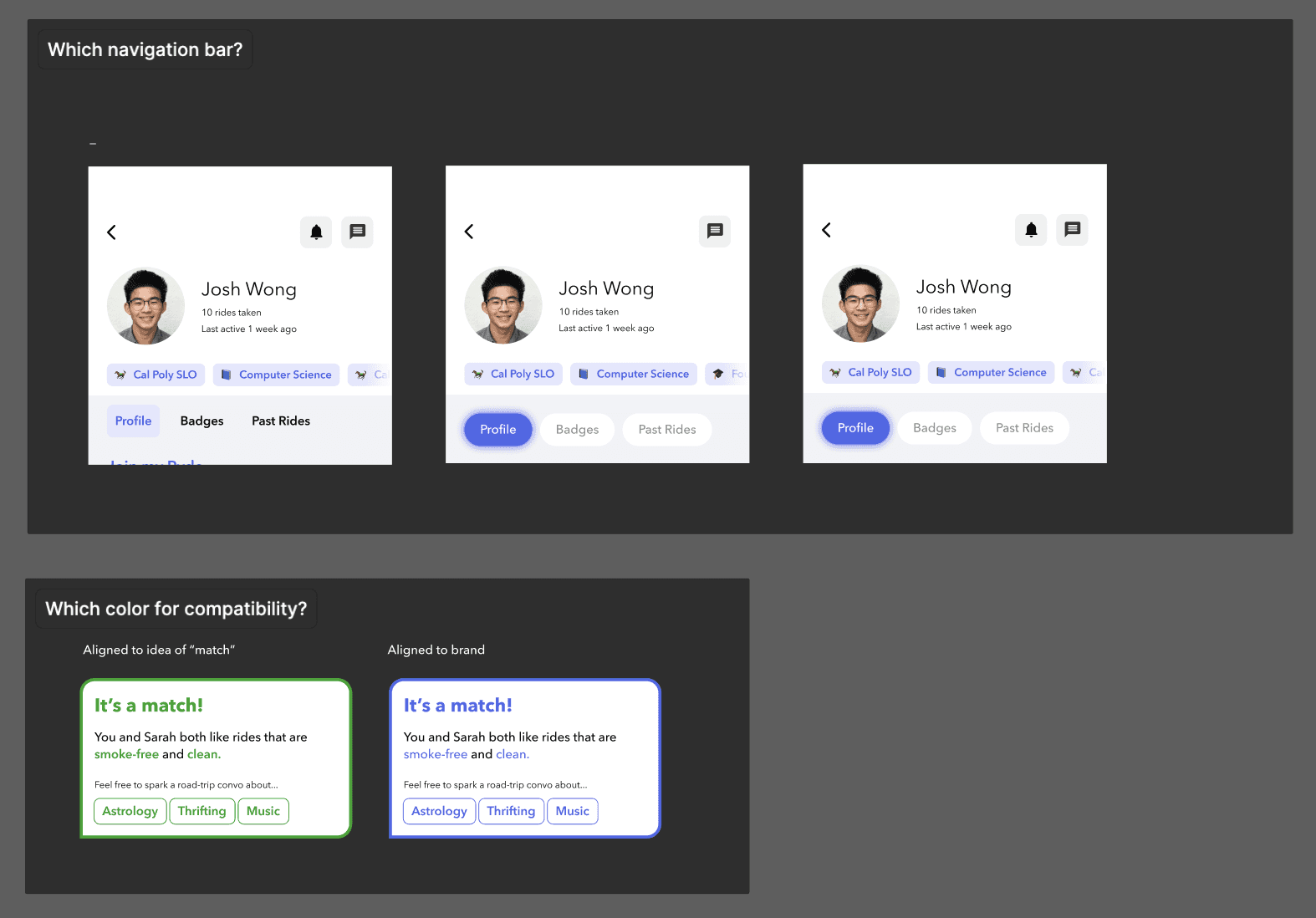
Riders and drivers wanted compatibility signals such asmusic taste, chattiness, car vibe, stop willingness. But a long profile questionnaire feels like a job application. Tags let users express personality in a low-effort, scannable format without writing a bio.

Why not a bio? Freeform bios have completion rates near zero in apps with optional fields. Tags are constrained, fast, and expressive and they feed the matching algorithm without cognitive load.

When we presented this in standup, the Ryde team confirmed users in their own research had been excited about it. We kept the vocabulary flexible and suggested tags plus write-your-own to avoid making it feel prescribed.
DECISION 03

Adventure Gallery: from utility to identity

Retention beyond the transaction

Ryde profiles were purely functional. There was no personality, no reason to return after a ride was booked. Ryde's founders wanted users engaged between trips, not just during booking.

The Adventure Gallery let users post photos and videos from their rides: road trips, scenic stops, carpooling moments. Inspired by Airbnb's approach to user-generated content, we designed it to feel editorial rather than social feed: photos with captions, organized by trip. One constraint deliberately scoped out: live maps and real-time location which was validated in research but deprioritized by Ryde as a later engineering phase.

DECISION 04

Badges: turning data into trust signals

Stats that already existed, finally visible

Ryde was already collecting rich data: miles traveled, rides completed, CO2 saved, money saved, but none of it appeared on profiles. A driver with 30 completed trips looked identical to someone with zero.

"They're collecting stats — showcase them." — Ryde Co-founder 2 (client standup)

Badges surface those stats as earnable achievements which acts as trust signals for riders, motivation for drivers. Badge taxonomy shaped directly by client standups: alumni badges that expire post-graduation, locked badges that show what you're working toward, event-specific badges tied to Ryde community moments.

PROCESS

OUTCOME

Profile 2.0 addressed the three structural failures in Ryde's original profile.

Over 8 weeks of standups, Ryde's founders confirmed all four feature directions for their next development cycle. Reviews and ID Tags were flagged as highest priority, directly mapping to the two pain points our research scored most severe.

Rider-side profiles were validated as the planned next phase: an expansion our focus group had already surfaced and we had deliberately scoped for later.

REFLECTION

"Reviews aren't a feature problem — they're a behavior problem. People don't leave honest feedback when they feel socially exposed."

The anonymous toggle was a small design decision that took the longest to get right, because it required understanding why users were holding back before I could design something that actually changed the behavior.

Working directly with Ryde's founders taught me that the best client relationships aren't sign-off loops but rather they're collaborations. Emily's email about the review system didn't just give me direction; it gave me a new frame for the problem. That's the kind of feedback that makes design better.

Smooth Scroll
This will hide itself!